
cv | works | sculptures | site specific | environmental | land art | architectural | publications | exhibitions | symposia/lectures | cities | encounters | accounts
CITIES - sculptures and land art
Beemster
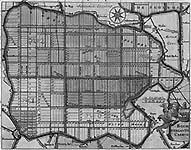
He chose the long and straight (as are all the roads in the Beemster Polder) Jisper Road (Jisperweg). It had broad shoulders which would make it possible for him to utilize this space. To make this very linear system tangible he decided to place a row of willows at an angle with the omnipresent grid.
Willows are a very normal attribute of a Dutch polder - there just are no polders without them. The white willow grows very well in moist soil - and this tree has all but become a trademark of Lucien den Arend's environmental projects.
He placed the row of one hundred willows at an acute angle (15 degrees) to the axis of the Jisperweg in such a way as to bisect it. The people driving on the road are taken by surprise by this seemingly normal row of willows slowly approaching them as they reach to point where they actually pass through it.

HIC•SALICUM•ORDO•VIAM•SECAT•JISPINAM•IN•ANGULO•ACUTO - 1987-1988 - Salix Alba (white willow) - length 100m - Beemster Polder NL
(The title of the work was den Arend's answer to the trendy Latin titles which were en vogue in the art world of the period. So with the aid of a Latin scholar-friend he translated this variety of willows bisects the Jisper Road at an acute angle and they gave the sentence a more authentic flavor by shifting the verb to a position in the sentence between the objects it cuts.)
As with his Salix Alba environmental project in Delft, the man with the lawn mower opposed him - being used to mow a grid he decided not to divert when he first encountered the obstruction and took his tractor and heavy mowing mechanism straight over this recalcitrant row of trees. Behind him they straightened again. And after a talk with the organization he learned to steer free of the willows until they were removed a year later.
next
3D anaglyph
photographs of my sculpture
works©author: Lucien
den Arend
© 1998/present - denarend.com
this site was developed by
DutchDeltaDesign
Penttilä
Seppäläntie 860 51200
Kangasniemi Finland
telephone +358 (0)44 264 12 12
